Introduction
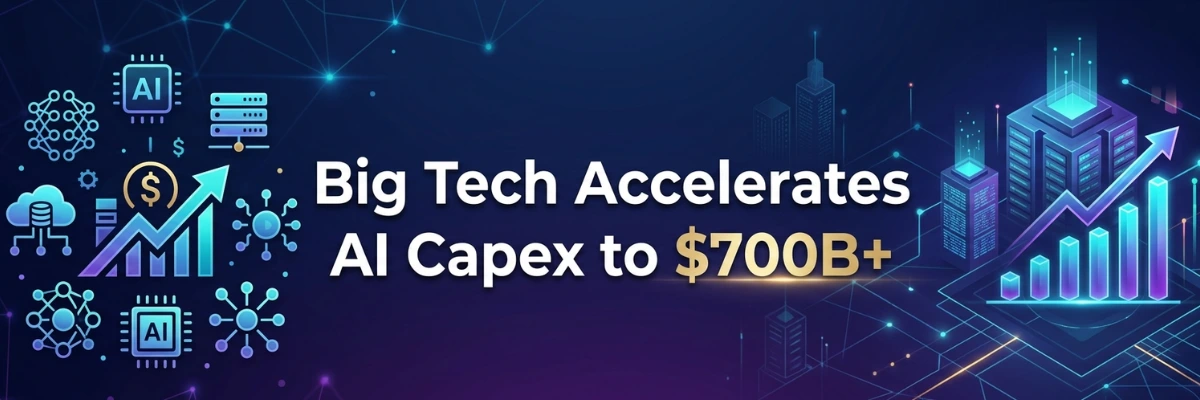
Big Tech Accelerates AI Capex to $700B+ . Global tech giants like Microsoft, Amazon, Google, and Meta are projected to spend over $700 billion on AI infrastructure in 2026.
This includes massive investments in data centers, AI chips, and cloud ecosystems.
The move signals a major shift—AI is no longer just about software, but about owning the infrastructure that powers it.
What Happened
Massive AI Infrastructure Investment
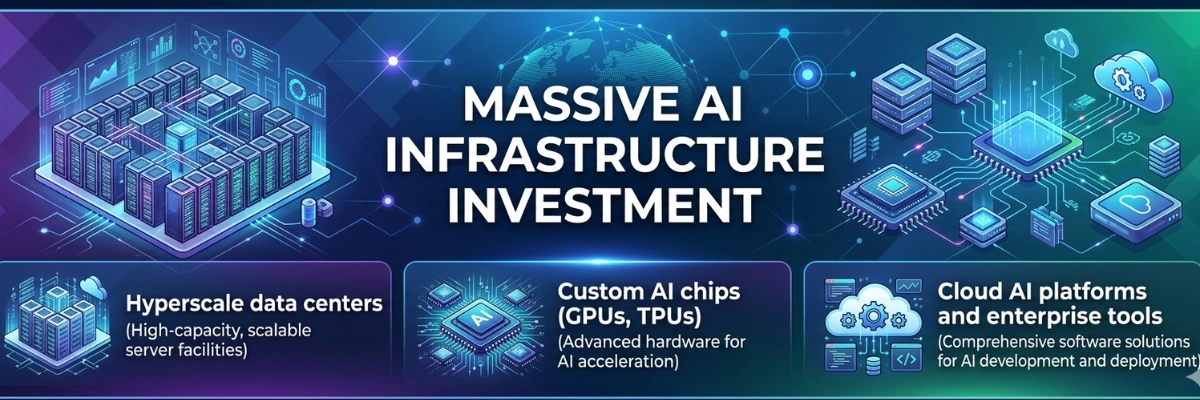
Big Tech companies are significantly increasing capital expenditure (CapEx) to build and scale AI infrastructure. These investments focus on:
- Hyperscale data centers
- Custom AI chips (GPUs, TPUs)
- Cloud AI platforms and enterprise tools
Key Players Involved
Chipmakers like NVIDIA are seeing massive demand, while supply chain leaders such as TSMC and ASML play critical roles in enabling production.
Why It Matters
The surge is driven by rapid adoption of generative AI, enterprise AI integration, and increasing competition to build more powerful AI models.
Analysis / Insights
1. Market Impact
The semiconductor and cloud industries are entering a high-growth phase, with AI infrastructure emerging as a multi-trillion-dollar opportunity. Demand for advanced chips and compute power is reshaping global supply chains.
2. Business & Growth Strategy
Big Tech is shifting from asset-light software models to infrastructure-heavy strategies. Owning compute resources allows companies to control performance, reduce long-term costs, and scale AI capabilities efficiently.
3. Competitive Positioning
Microsoft strengthens its enterprise edge through partnerships like OpenAI, while Google leverages proprietary TPUs. Amazon focuses on AWS ecosystem dominance, and Meta pushes open-source AI strategies.
4. Industry Implications
Rising infrastructure costs may create barriers for startups, increasing dependence on Big Tech platforms. AI innovation could become more centralized among companies with large-scale compute access.
Key Takeaways
- AI is evolving into an infrastructure-first industry
- Control over compute power will define future market leaders
- Businesses must align with the right cloud and AI ecosystems
- AI development costs are likely to increase
- Strategic partnerships will become essential for growth
Industry Trend / Bigger Picture
This shift represents the rise of AI industrialization, similar to the cloud computing boom of the 2010s. Compute power is becoming a strategic asset, and AI capabilities are concentrating among a few dominant players.
Conclusion / POV
The $700B+ investment wave is not just about scaling AI—it’s about controlling the future of the digital economy. Companies that own the full AI stack—from hardware to software—will lead the next era of innovation.For businesses, the key question is no longer whether to adopt AI, but which ecosystem to build on.
Find the teams driving growth and engagement across every platform. Check out the top digital marketing agencies in our directory.