Introduction
The global tech industry has already recorded 92,000+ Tech Layoffs in 2026, signaling a significant workforce shift. Major companies including Google, Microsoft, and Amazon are among those restructuring teams.
The key driver: rapid adoption of AI and automation tools.
This matters because it reflects a structural shift—not just cost-cutting—impacting jobs, skills, and business strategies globally.
What Happened: Breaking Down 92,000+ Tech Layoffs in 2026
The tech sector has witnessed over 92,000 job cuts in 2026, continuing the downsizing trend seen in previous years but with a sharper AI focus.
Key Facts
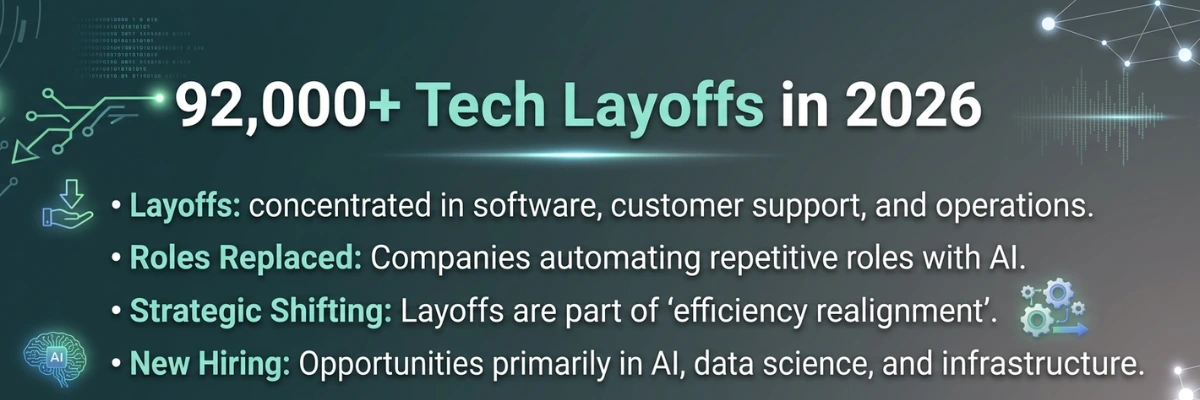
- Layoffs are concentrated in software engineering, customer support, and operations roles
- Companies are replacing repetitive roles with AI-driven systems
- Hiring is still happening—but primarily in AI, data science, and infrastructure roles
- Many layoffs are part of “efficiency realignment” strategies
Why Now?
- Generative AI tools are reducing the need for large teams
- Businesses are optimizing costs amid economic uncertainty
- Faster product cycles require leaner, more specialized teams
For reference on ongoing layoffs tracking, see platforms like
👉 https://layoffs.fyi/
Analysis / Insights
1. Market Impact
The 92,000+ Tech Layoffs in 2026 indicate a shift from workforce expansion to AI-led efficiency models. Public markets have largely rewarded companies that cut costs and improve margins.
2. Business Strategy Shift
Companies are reallocating budgets:
- From headcount → AI infrastructure
- From manual processes → automation systems
This signals a long-term transformation rather than a temporary correction.
3. Competitive Positioning
Organizations investing aggressively in AI are gaining an edge:
- Faster product development
- Lower operational costs
- Scalable customer experiences
Late adopters risk becoming uncompetitive.
4. Talent & Workforce Impact
- Demand is rising for AI specialists, prompt engineers, and ML engineers
- Traditional roles face declining stability
- Upskilling is becoming mandatory, not optional
Key Takeaways (Actionable Insights)
- Businesses should prioritize AI integration to stay competitive
- Workforce planning must shift toward skill-based hiring, not role-based hiring
- Marketers should leverage AI tools for content, analytics, and personalization
- Organizations must invest in employee upskilling programs
- Cost optimization strategies should balance automation with innovation
Industry Trend / Bigger Picture
The 92,000+ Tech Layoffs in 2026 are part of a broader transition into an AI-first economy.
We are moving from:
- Human-heavy operations → AI-augmented systems
- Scale via hiring → Scale via technology
This mirrors past industrial shifts, where automation redefined entire industries—but at a much faster pace.
For deeper insights into AI’s economic impact, refer to
👉 https://www.mckinsey.com/capabilities/quantumblack/our-insights/the-economic-potential-of-generative-ai
Conclusion / POV
The current wave of layoffs isn’t simply about reducing costs—it’s about rebuilding organizations around AI.
Companies that adapt quickly will lead the next decade, while others may struggle to remain relevant.
The real question is no longer “Will AI replace jobs?”
It’s “How fast can businesses and professionals adapt to AI-driven change?”
Find the teams driving growth and engagement across every platform. Check out the top digital marketing agencies in our directory.