Introduction
Why Google Is Winning the AI War is becoming clearer as the company doubles down on its biggest advantage: compute power.
With massive infrastructure, custom chips, and vertically integrated AI systems, Google is positioning itself ahead of rivals like OpenAI and Microsoft.
This shift matters because AI leadership is no longer just about models—it’s about who can run them at scale efficiently.
What Happened
Google has been aggressively investing in AI infrastructure, particularly:
- Its proprietary TPUs (Tensor Processing Units), now in advanced generations
- Expansion of global data centers optimized for AI workloads
- Deep integration across products like Search, Cloud, and Gemini AI models
Unlike competitors relying heavily on external GPUs (e.g., NVIDIA), Google controls both hardware and software stacks, allowing tighter optimization and lower long-term costs.
👉 Learn more about Google’s AI infrastructure strategy:
https://cloud.google.com/blog/topics/ai-machine-learning
Core Development
The key shift is this:
Compute capacity has become the defining moat in AI.
While many companies can build models, very few can:
- Train them at massive scale
- Deploy them globally with low latency
- Sustain costs over time
Google’s ecosystem—spanning chips, cloud, and consumer platforms—creates a closed-loop advantage that competitors struggle to match.
Analysis / Insights
1. Competitive Positioning
Google is transitioning from a “research-first AI company” to a full-stack AI powerhouse.
Owning infrastructure reduces reliance on third parties and strengthens long-term defensibility.
2. Business Strategy Shift
Instead of competing only on model performance, Google is focusing on:
- Cost efficiency per AI query
- Infrastructure scalability
- Enterprise cloud adoption
This aligns closely with its Google Cloud growth strategy.
👉 Reference:
https://www.alphabet.com/investor
3. Market Impact
- AI costs are becoming a key differentiator
- Companies without infrastructure may face margin pressure
- Cloud providers with compute advantages gain enterprise dominance
4. Industry Implications
The AI race is evolving into:
Model War → Infrastructure War
This redefines how startups and enterprises approach AI adoption.
Key Takeaways
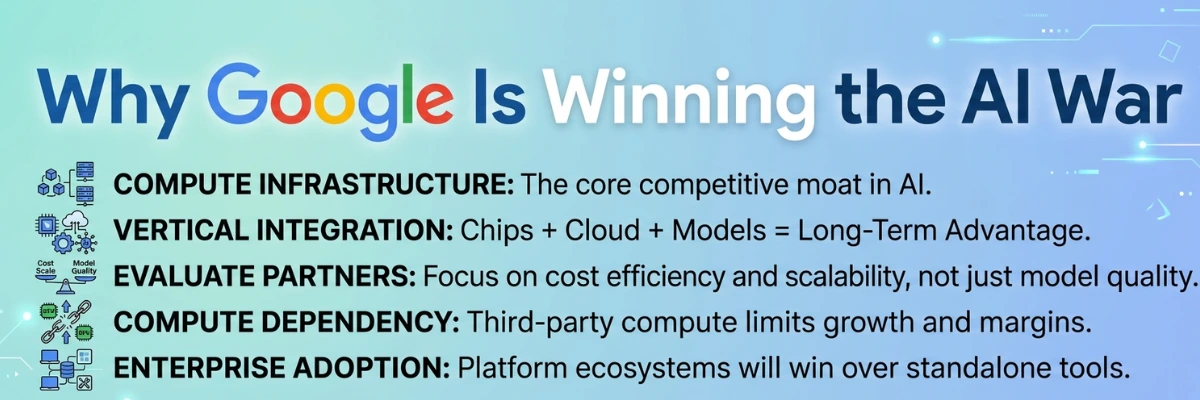
- Compute infrastructure is now the core competitive moat in AI
- Vertical integration (chips + cloud + models) creates long-term advantage
- Businesses should evaluate AI partners based on cost efficiency and scalability, not just model quality
- Dependency on third-party compute (e.g., GPUs) can limit growth and margins
- Enterprise AI adoption will increasingly favor platform ecosystems over standalone tools
Industry Trend / Bigger Picture
The broader trend behind Why Google Is Winning the AI War is the rise of “Compute Capitalism” in AI:
- AI is becoming infrastructure-heavy, similar to cloud computing
- Control over chips and data centers is consolidating power among a few players
- Smaller AI companies may shift toward API-based models instead of building from scratch
This mirrors how cloud giants previously reshaped software markets.
Conclusion / POV
Google’s advantage isn’t just better AI—it’s cheaper, faster, and more scalable AI.
If this trajectory continues, the winners of the AI race won’t just be the smartest—but the ones with the deepest compute stacks.Businesses should adapt early by aligning with platforms that can scale with them.Find the teams driving growth and engagement across every platform. Check out the top digital marketing agencies in our directory.