Introduction
The marketing landscape in 2026 is evolving faster than ever.
With artificial intelligence, automation, and real-time data becoming the backbone of modern strategies, businesses are no longer just experimenting with technology—they are fully dependent on it.
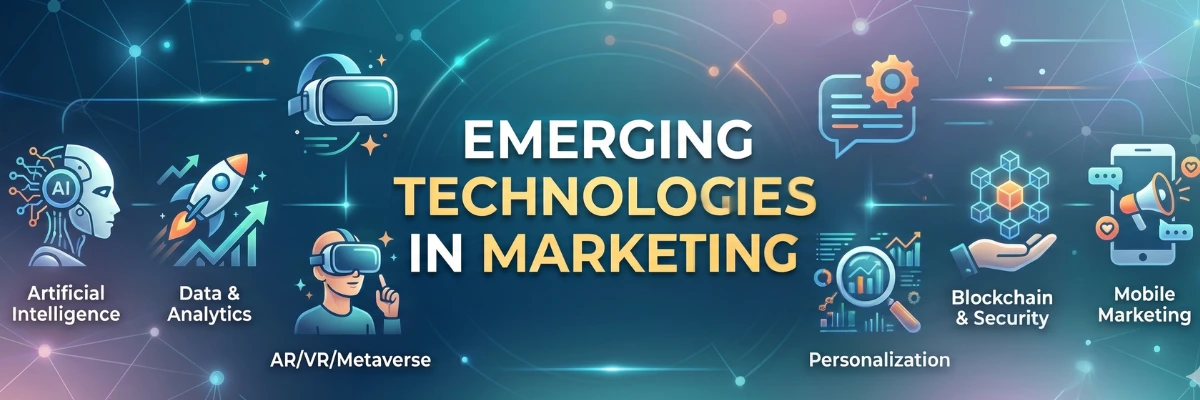
Emerging Technologies in Marketing are reshaping how brands connect, communicate, and convert customers. From predictive AI models to hyper-personalized experiences, marketers now operate in a world where speed, precision, and relevance define success.
In this blog, we will explore the latest trends, innovations, and technologies shaping marketing in 2026.
Key Marketing Technology Trends Shaping 2026
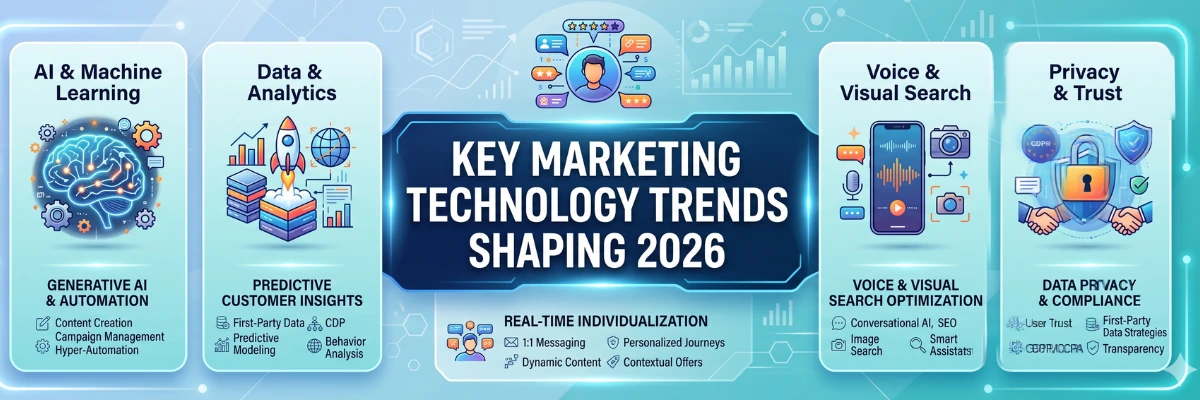
AI-First Marketing Strategies
In 2026, AI is no longer just a support tool—it has become the core decision-maker.
Brands are now using AI to predict customer behavior, automate campaign decisions, generate content, and optimize ads in real time.
This allows marketers to create smarter and faster campaigns with better results.
Hyper-Personalization at Scale
Personalization has evolved into hyper-personalization.
Instead of targeting broad segments, brands now create one-to-one experiences using real-time user data.
This approach improves engagement, increases customer retention, and delivers higher ROI.
Consumers now expect brands to understand their needs instantly.
Marketing Automation 2.0
Marketing automation has moved far beyond basic email scheduling.
In 2026, automation includes AI-powered workflows, smart lead nurturing, automated customer journeys, and multi-platform campaign execution.
This helps marketers focus more on strategy while automation handles repetitive tasks.
Voice, Visual & Conversational Marketing
User behavior is changing rapidly.
People now search using voice, images, and conversations instead of just typing.
Key trends include voice search optimization, AI chatbots, visual search, and conversational funnels.
Brands must adapt to these new interaction styles to stay relevant.
Next-Gen Marketing Technologies & Innovations
Advanced Customer Journey Intelligence
Customer journey mapping is now dynamic and AI-driven.
Businesses can track user behavior in real time, predict actions, and create personalized touchpoints.
This helps identify drop-offs, improve experience, and increase conversions.
Smart Digital Marketing Platforms
Modern marketing platforms are now fully integrated systems.
They combine CRM, analytics, advertising, and automation into one place.
This improves efficiency and helps marketers manage everything from a single dashboard.
Predictive Marketing Analytics
Analytics in 2026 focuses on future outcomes rather than past data.
Predictive tools help marketers forecast campaign success, identify high-value customers, and optimize budgets.
This leads to better decision-making and reduced risk.
AI Content & Text Generation Evolution
AI content tools have become more advanced and widely used.
They can generate blogs, ads, emails, and SEO content quickly.
However, the best results come from combining human creativity with AI efficiency.
How Businesses Can Adapt to Martech in 2026
Invest in AI Education
Many marketers still struggle with AI tools.
Learning and upskilling in AI is now essential for growth.
Focus on Data-Driven Decision Making
Data plays a crucial role in modern marketing.
Businesses must collect, analyze, and use data effectively to stay competitive.
Balance Automation with Creativity
Automation improves efficiency, but creativity builds brand identity.
Both are equally important for success.
Prioritize Customer Experience
Customer experience is now more important than ever.
Brands that provide smooth, personalized journeys will win in the long run.
Impact of Emerging Marketing Technologies
For Businesses
Businesses benefit from higher ROI, better targeting, and scalable growth.
For Consumers
Consumers enjoy more relevant ads, personalized experiences, and faster communication.
For the Economy
Marketing technology is driving job creation, digital growth, and innovation across industries.
Future Outlook of Marketing Technology
Marketing will continue evolving with advancements in AI, AR/VR, real-time personalization, and privacy-focused strategies.
Businesses that adopt these technologies early will gain a strong competitive advantage.
Conclusion
The shift towards AI, automation, and hyper-personalization is not just a trend—it is the future.
Emerging Technologies in Marketing are transforming how brands operate and connect with customers.
To succeed in 2026 and beyond, businesses must stay adaptable, embrace innovation, and continuously evolve with technology.